
'During his visit to Vietnam on September 3 -- the first visit by an Indian prime minister in 15 years -- Modi will notice the widespread anti-China sentiment in that country.'
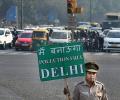
Friday will be the first day of the second phase of the odd-even scheme in New Delhi.

If November 9 ushers in a Hillary Clinton presidency, you can bet your last dollar that Huma Abedin will be back at POTUS' side.
'India needs to closely monitor the discussions at the UNSC and make counter-measures as this touches its core interests', points out Srikanth Kondapalli.

The rising popularity of Heritage Walks is uncovering forgotten historic sites all over India.
'In the present era of strategic uncertainty and rapidly changing threats, no military professional now disputes the unavoidable necessity of a joint planning staff for the planning and conduct of joint operations so that integrated operations can be planned 'top down',' says Brigadier Gurmeet Kanwal (retd).

He said India can have a possible role in creating a multilateral forum of negotiations between the Palestinians and Israelis.

Will the next generation possess an even more internationalist outlook, and lose their Indian identities entirely? Will they continue to believe in a larger role for business in society and go beyond the boardroom to truly understand the Indian consumer, ask Geoffrey Jones & Vinay Sridhar of Harvard Business School.

Make the most of these eight weeks to optimise your score and secure admission in a top b-school.

'We should build a military with the capability to fight today's war on priority -- balancing it with the requirements of the future,' says Lieutenant General Anil Chait, one of the Indian Army's most cerebral thinkers who recently retired as chief of the Integrated Defence Staff, in his agenda for the new defence minister.

The BRICS summit made clear that China's support for Pakistan is unwavering. China will continue to pressure India to ease tensions with Pakistan and resolve the Kashmir dispute.

The new government needs to clearly insist on diplomatic reciprocal arrangements with China. While reciprocity is a function of power in bilateral relations, the Modi-led government's responses should be based on India'S inherent strengths, says China expert Srikanth Kondapalli.

The failure to restructure our armed forces in line with contemporary needs 14 years after the Kargil war will impose strategic costs beyond just delays and scandals, says Nitin Pai


A K Bhattacharya digs into the yet-to-be-public report on ways to curb black money and finds out that Modi's next moves could include action on dabba trading, hawala, and education.

Ahead of the G-20 summit in Osaka this week, Xi has reasserted China's role as a global player, points out Dr Rajaram Panda.
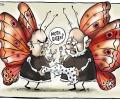
With all the brouhaha over GST, and (often) a limited understanding of the long-term forces shaping India's logistics sector, companies seem to have omitted factoring in some underlying trends that could shape supply chain excellence, says Neelesh Mundra.

India has an unprecedented opportunity to develop solar industry because like China, it offers scale which is critical to reducing costs and to stimulate innovation, says Shyam Saran.
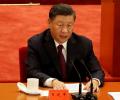
'The world does not care about the tension on our border.' 'India has to emerge as a strong economic power.' 'Respect comes when the world sees a country with a direction and leadership that has a vision,' points out Ramesh Menon.
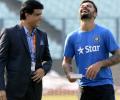
'Somewhere along the way, elected office-bearers appeared to have lost sight of the interest of cricket and begun to pursue their own interpretation of what the game should be.' 'Families made it a tradition to have their representatives occupy, if not usurp, positions in state associations,' points out Vinod Rai, who will step down as head of the BCCI's Committee of Administrators on Wednesday, October 23.

'China's growing nexus with Pakistan and the two countries' unresolved territorial disputes with India continue to pose a formidable national security threat to India,' says Brigadier Gurmeet Kanwal (retd).
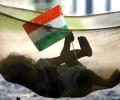
Jaitley said among various reforms labour laws will remain a challenge.

Five Indian-Americans have been named among the 400 richest people in the US by Forbes, a list topped by Microsoft co-founder Bill Gates for the 21st year in a row with a net worth of $81 billion.

Colonel Anil Athale (retd) recalls how the Battle of Panipat, 258 years ago, changed the history of India for the next century and half.

In our series on Super30 achievers, we find out how Aquibur Rahman has fared since he cleared his IIT-Joint Entrance Exam.

'Nobody is going to fight India's war.' 'India has to fight its own war against the rogue State and the evil forces nurtured by it.'

'He is seeking to harness the power of Indian Diasporas to national (support for India in global capitals) and political (enhance the Bharatiya Janata Party's support base) ends.'

Describing the Narendra Modi-led BJP's electoral victory as a "breathtaking landslide", eminent American think tanks and experts have said the win has given him an opportunity to "redefine" Indian politics.
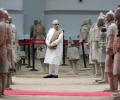
India, China must further strengthen business ties for growth.

Since 55 per cent of Indian trade passes through the South China Sea, and with over $5 billion investments in the energy sector in Vietnam, it is imperative India actively pursues its national interests in the region, says Srikanth Kondapalli.

The results of the recent presidential elections in Sri Lanka are likely to have stunned groups in Tamil Nadu that have been giving moral and material support to Tamils in the north and east of the island for decades. Tamil Nadu-based groups had asked Sri Lanka Tamils to protest against the election and boycott voting.

Anusha Jain was 21 when she took over her father's business. In four years, she has clocked 1.5x growth for the company.

'Only when India's adversaries are convinced that India has both the necessary political and military will and the hardware to respond to a nuclear strike with punitive retaliation that will inflict unacceptable loss of human life and unprecedented material damage, will they be deterred,' says Brigadier Gurmeet Kanwal (retd).
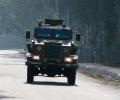
'The devious minds across the border will test us to the hilt, but in the course of that will offer us opportunities for which we must be prepared,' says Lieutenant General Syed Ata Hasnain (retd), who commanded the Uri Brigade, the Baramulla Division and the Srinagar-based Chinar Corps.

Delays in implementing power projects, mainly due to fuel issues, could turn Rs 1 lakh crore of bank loans into NPAs if prompt action is not taken, according to a study by KPMG.
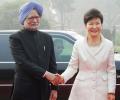
South Korean President Park Geun-hye's visit to India will enhance economic and military ties between the two countries and give the relationship a strategic dimension, says Jiye Kim.
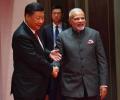
'We must compartmentalise issues, ensuring that one disagreement does not sour everything,' advises Ambassador Kishan S Rana.
Vishal Sikka who was made vice-chairman till his successor was appointed, also quit the board with immediate effect.
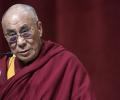
China is worried about the situation post the Dalai Lama and that his reincarnation could surface in Arunchal Pradesh, a region it claims as its own, but which is part of the Indian Republic, says former RA&W Additional Secretary Jayadeva Ranade.

The increase in home-grown radicalised Islamic groups and the rise of Islamic State and Al Qaeda in Bangladesh should be a matter of worry for India, which shares a 4,100 km border with its eastern neighbour, says Rajeev Sharma.
